New Roots, New Phoenix: The Immigrant Visionaries Quietly Rebuilding the Valley From the Inside Out
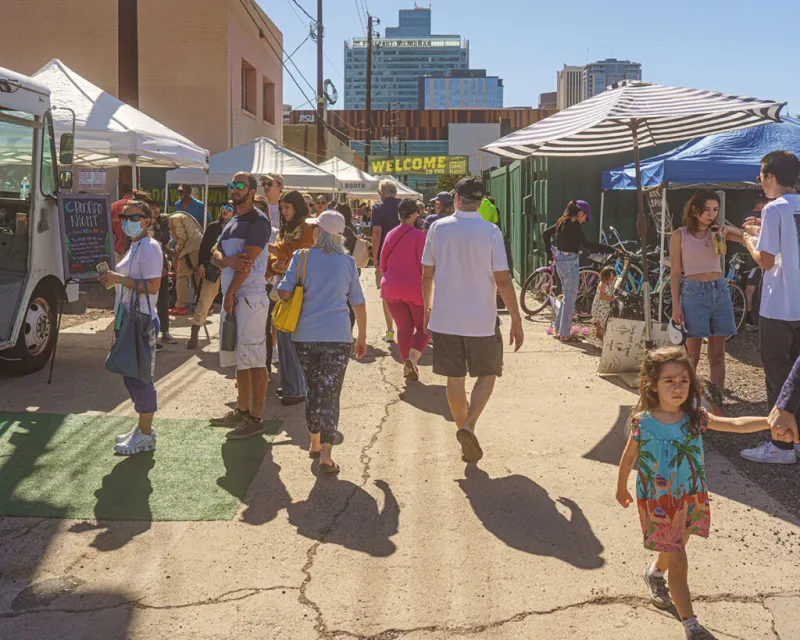
Photo: diverse immigrant community business owners Phoenix Arizona street market, via phoenixbiosciencecore.com
There's a stretch of road in South Phoenix where the signage shifts languages mid-block. A hand-painted banner in Somali hangs above a grocery store stocked with injera and imported spices. Next door, a Mexican panadería has been running since before half the neighborhood was built. Across the street, a Guatemalan family just opened a tailor shop, their window display a bright collision of embroidered fabric and hand-lettered price tags.
This is Phoenix in 2025 — not the Phoenix of postcards and resort brochures, but the real one. The one that hums with ambition, improvisation, and an almost stubborn refusal to be overlooked.
Building Something From Nothing (Again)
For decades, the dominant narrative around Arizona immigration has been political — a tug-of-war between enforcement and advocacy, border policy and identity. But on the ground, the story playing out in neighborhoods across the Valley is far more practical, and honestly, far more interesting.
Take Fatuma Osman. She came to Phoenix from Mogadishu in 2011 through a refugee resettlement program and spent her first years working double shifts at a hotel near Sky Harbor. By 2019, she'd saved enough to open a small halal butcher shop in a strip mall on 35th Avenue. Today, that shop has expanded twice, employs seven people — most of them also East African refugees — and has become a de facto community hub where people gather after Friday prayers to share news and swap job leads.
"People think we just came here to survive," Fatuma says, stacking cuts of meat with practiced efficiency. "We came here to build. That's what we do."
Her story isn't unique. It's part of a broader pattern researchers and city planners are only beginning to fully appreciate: immigrant entrepreneurs in Phoenix are creating what economists call "enclave economies" — dense networks of businesses and services that circulate money within a community while simultaneously generating jobs and tax revenue for the city at large.
The Cultural Infrastructure Nobody Talks About
Beyond the economics, there's something harder to quantify but just as significant happening in the Valley's immigrant communities: the slow, deliberate construction of cultural infrastructure.
In Mesa's Dobson Ranch area, a collective of first- and second-generation Vietnamese artists has been quietly operating a shared studio and gallery space for the past three years. They don't have a flashy name or a big social media presence. What they have is a rotating exhibition wall, a ceramics kiln, and a monthly gathering that draws Vietnamese elders, curious neighbors, and local art students in roughly equal measure.
Thanh Nguyen, one of the collective's founding members, describes it as filling a gap that mainstream arts institutions haven't bothered to address. "There are Vietnamese artists all over the Valley," he says. "But we were all isolated. Nobody was connecting us, so we connected ourselves."
That DIY spirit — connect yourself, build what doesn't exist, don't wait for permission — shows up again and again in conversations with immigrant community members across the Phoenix metro. It's a philosophy born partly from necessity and partly from a cultural tradition of communal self-reliance that predates anyone's arrival in Arizona.
From the Sidewalk to City Hall
The political dimension of this story is just as compelling. A new wave of civic leaders with immigrant backgrounds is moving into positions of influence across the Valley, reshaping the conversation about who gets to define Phoenix's future.
Some of that shift is happening through traditional electoral politics. Others are working through community organizations, school boards, and neighborhood associations — the quieter levers of local power that rarely make headlines but shape daily life in profound ways.
Marisol Herrera grew up in Maryvale, the daughter of parents who immigrated from Oaxaca in the early 1990s. She spent years working as a community organizer before joining the staff of a Phoenix city council member's office. Now she's running for a local school board seat, with a platform built around bilingual education and mental health resources for immigrant youth.
"My parents didn't have anyone at the table speaking their language — literally or figuratively," she says. "That's what I'm trying to change. Not for them anymore, but for the kids who are where I was twenty years ago."
Herrera is part of a generation that has moved fluidly between cultures their entire lives, code-switching with ease and drawing strength from both sides of the hyphen in their identities. They're not choosing between being American and being Oaxacan, or Somali, or Vietnamese. They're insisting on being both, fully.
The Heritage Question
One of the most nuanced threads running through all of these stories is the question of preservation. How do communities maintain cultural identity while integrating into a city that's constantly changing around them?
The answers are as varied as the communities themselves. Some lean into formal institutions — cultural centers, language schools, religious organizations that double as social anchors. Others find more informal solutions: WhatsApp groups that function as neighborhood watches and job boards simultaneously, backyard celebrations that keep traditional music and food alive for the next generation, small businesses that are as much about cultural continuity as they are about commerce.
At a Eritrean coffee ceremony in a living room off Camelback Road, a grandmother named Almaz explains the ritual to three teenagers who are clearly more comfortable in English than Tigrinya. She doesn't seem bothered by the translation gaps. "They will remember the smell," she says simply. "The smell stays."
There's something quietly profound in that. Culture doesn't always survive through formal transmission. Sometimes it survives through the senses, through habit, through the particular texture of a community gathering on a Tuesday night in a suburb that didn't exist thirty years ago.
A Valley Wide Enough for All of It
Phoenix has always been a city of reinvention. People come here to start over, to escape something, to build something new in the desert heat. That mythology is baked into the city's name — rise from the ashes, begin again.
What's different now is who's doing the reinventing, and on whose terms. The immigrant communities putting down roots across the Valley aren't arriving as blank slates, ready to be absorbed into a pre-existing culture. They're arriving as full human beings with histories, traditions, and ambitions that are actively reshaping the place they've chosen to call home.
The Phoenix that emerges from that process — from Fatuma's butcher shop and Thanh's art collective and Marisol's school board campaign — isn't going to look like the city of fifty years ago. It's going to look like something new.
And honestly? That sounds about right for a city named after a bird that burns itself down just to come back stronger.