Checkmate by Sundown: The Folding-Table Chess Scene Turning Phoenix Parks Into Clubhouses
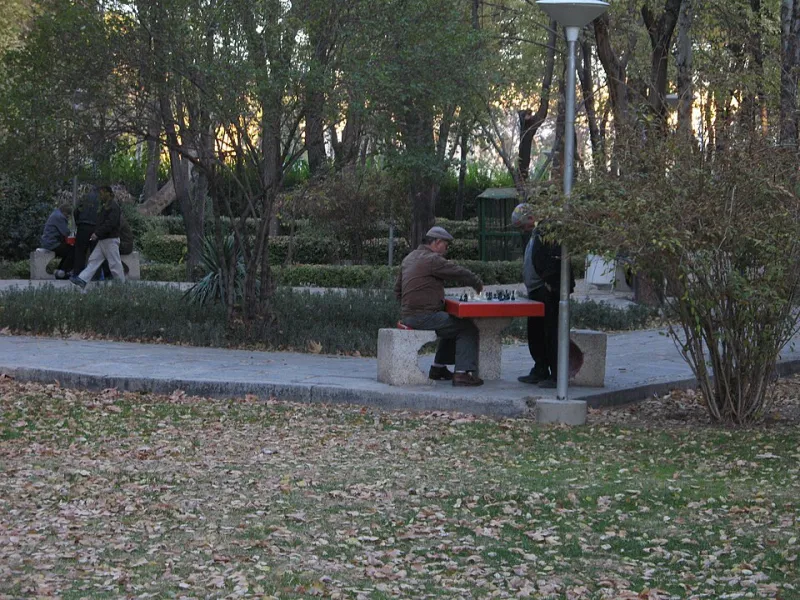
Photo: Ivan Mlinaric from Slovenia, CC BY 2.0, via Wikimedia Commons
Sunday afternoon at a park in central Phoenix, and the game at the shaded table is being narrated at full volume by a man in a lawn chair who is not playing in it.
“He's gonna take it. He's gonna take it. Don't take it. Aw, he took it.”
The player who took it says nothing. The player who lost it sighs, resets the pieces without being asked, and slides the board across the table to whoever's next.
This happens in parks all over the Valley nearly every day of the week — Encanto, Margaret T. Hance, Steele Indian School, a cluster of tables in Mesa, a corner of a Tempe park where the shade hits just right around four. The scene has no official organizer, no membership card, and no schedule posted anywhere. It runs on habit, folding chairs, and the fact that at any given moment somebody in this city is willing to play chess with a stranger.
The Regulars
Ray Delgado retired from the post office eleven years ago and has been coming to the same cluster of tables for about nine of them. He brings two boards, a bag of pieces, and a folding chair he keeps in his trunk specifically for guests.
“I don't play for the chess,” he says, and then immediately plays for the chess. “Okay. I play for the chess. But I come for the talking.”
At a neighboring table, three teenagers are playing blitz with a clock that has clearly been dropped on concrete. They're fast, they're loud, and at least one of them has an online rating that would flatten most of the adults in the park — a fact he is not shy about mentioning.
Then there are the passersby, which is the whole point. A guy walking his dog stops. A mother with a stroller watches two moves and gets pulled into a game. A vendor with a cooler of paletas sells three things and gets checkmated in eleven moves.
The Etiquette Nobody Wrote Down
Ask five regulars what the rules are and you'll get five versions, but the overlap is remarkable:
Don't touch another player's pieces. Not to adjust them, not to demonstrate a point, not even to admire them.
Don't offer advice unless you're invited. Park chess has a strong tradition of extremely loud spectators, but there's a line between commentary and coaching, and everybody knows where it is.
Take-backs are a privilege, not a right. In casual games, a beginner usually gets one. Ask for two and you'll get a look.
Resign like a grown-up. Dragging out a lost position to see if your opponent blunders is considered worse manners than losing badly.
The winner resets. Quietly, without ceremony, while the next challenger sits down.
The clock is sacred. In timed games, arguing with the clock is like arguing with the sun.
“The etiquette is the whole thing,” Delgado says. “You can be a terrible player out here and be welcome forever. You be a bad sport once and it's done.”
Speed Chess, Loud Edition
If the Sunday afternoon tables are a library with better weather, the Thursday evening crowd is closer to a sports bar without the bar. Blitz games, five minutes a side, played at a volume that carries across the grass. The trash talk is relentless and mostly terrible.
“You're playing like it's a school night.”
“That was a 2019 move. It's 2026, man.”
“You wanna think about that, or you wanna think about your life?”
The remarkable thing isn't the noise. It's who's making it. The loudest table on a recent Thursday had a nineteen-year-old, a woman in her seventies, and a guy in a work shirt still dusty from his shift, all rotating through the same board.
The Kid Problem (Which Isn't a Problem)
Every park scene has a moment where a teenager sits down across from an adult who assumes it'll be easy. The adults who've been around a while have learned to ask first.
“If a kid shows up with a clock in his bag, you're in trouble,” says Marcus Bell, who helps run an informal weekly gathering on the west side and coaches a handful of middle schoolers on the side. “That's the tell. Clock in the bag, no eye contact, hood up. You're about to get embarrassed for free.”
The mix of generations is the part regulars brag about most. Retirees get an afternoon of conversation. Kids get adults who take them seriously. Nobody has to pay for any of it.
Twenty Bucks and a Folding Table
Every few weeks, somebody decides it's time for a tournament. The format is usually improvised: a twenty-dollar buy-in, or free with a plaque and a bag of oranges, four or five rounds, a printed bracket somebody made the night before, and a time control designed so that nobody misses dinner.
These aren't sanctioned events. There's no rating authority, no arbiter, and no appeals process beyond majority opinion. What there is, is a permit, a card table, and sometimes a partnership with a neighborhood library that lends a room when the weather turns hostile in June.
The prizes are modest and the bragging rights are not. Several regulars say the bragging lasts longer than the cash ever does.
Why a Chess Table Is Civic Infrastructure
The Valley has no shortage of things to do that cost money. What it has fewer of is places where you can sit down next to someone you've never met — different age, different language, different neighborhood — and have a reason to stay for an hour.
At one table on a recent Sunday, four languages were in use across three games. Chess was the only one everybody shared. Nobody needed a name tag or an introduction. The board did that part.
By seven the light is going orange and the boards start coming apart. Delgado wipes down the pieces with the edge of his shirt, snaps the latch on his case, and folds his chair with the practiced motion of a man who has done it a few thousand times.
“Same time next week,” he says, to nobody in particular. It's not a question, because it doesn't need to be.