More Than Books: How Phoenix's Public Libraries Became the Valley's Most Unexpected Gathering Places
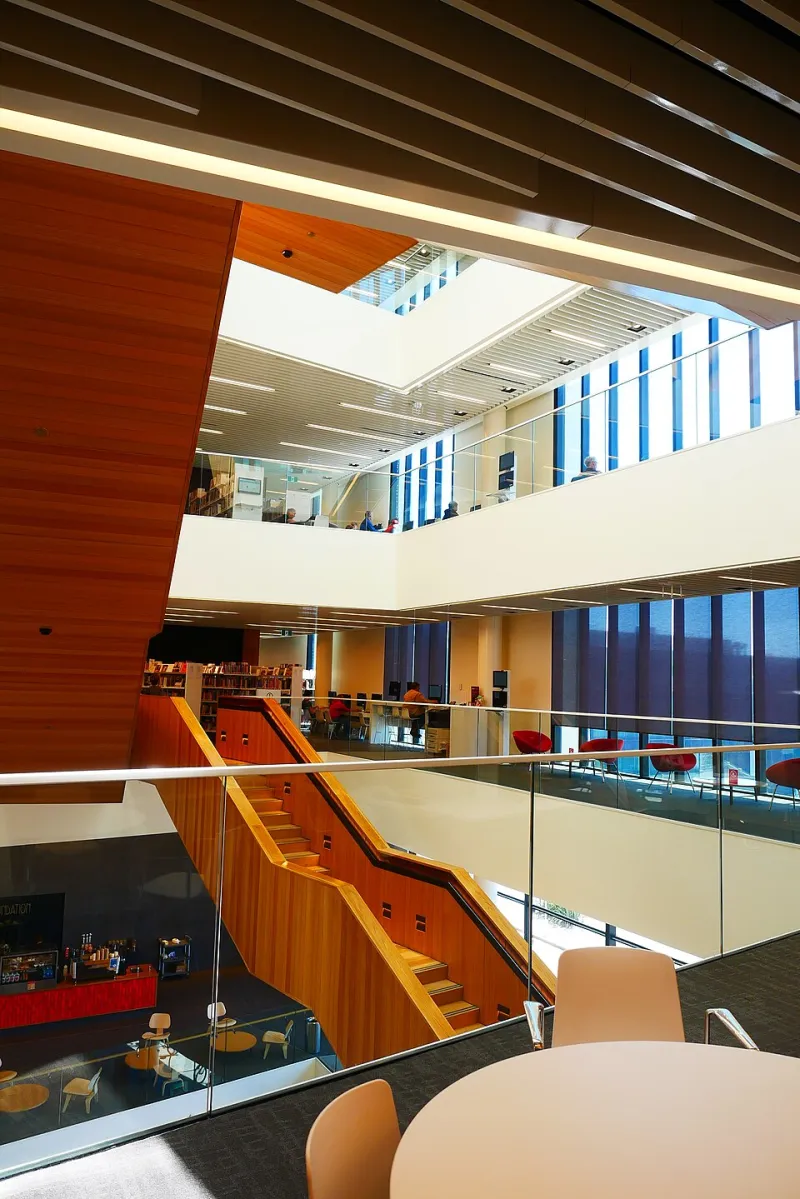
Photo: Sgerbic, CC BY-SA 4.0, via Wikimedia Commons
There's a woman named Dolores who shows up at the Burton Barr Central Library every single weekday at 9:03 a.m. — two minutes after the doors open. She takes the same chair near the east-facing windows, spreads out a worn spiral notebook, and gets to work. Some days she's studying for a citizenship exam. Other days she's helping a neighbor fill out a job application on one of the public computers. On Fridays, she teaches an informal conversational English group to four other women from her apartment complex.
Dolores doesn't work for the library. Nobody pays her to be there. She just figured out what a lot of Phoenix residents are quietly discovering: the public library isn't really about books anymore. Or rather, it's about a whole lot more than that.
A Building That Holds Everything
Phoenix operates 17 public library branches spread across a city that sprawls wider than some entire states. And while plenty of Valley residents drive past them without a second thought — maybe assuming they're relics of a pre-Google era — something genuinely remarkable is happening inside.
Branch librarian Mireya Castillo at the Cesar Chavez Library in South Phoenix has watched the transformation up close over the past eight years. "People come in for a book and end up staying for a program. Or they come for the AC and end up leaving with a library card and a whole new plan for their week," she says with a laugh. "We stopped thinking of ourselves as just a place that lends things. We're a place that connects people."
That shift in identity is real and measurable. The Phoenix Public Library system now runs over 1,400 programs annually — ranging from financial literacy workshops and resume clinics to cultural heritage celebrations, youth coding camps, and mental health resource fairs. Attendance at community events has grown steadily even as national library circulation numbers have fluctuated. People aren't just borrowing fewer physical books; they're showing up in person for entirely different reasons.
The Regulars Nobody Talks About
Spend a few hours at any branch and a portrait of Phoenix you won't find in tourism brochures starts to emerge.
At the Mesquite Branch near the east side, a group of retired veterans gathers every Thursday for what they loosely call a "current events circle" — part debate, part therapy, part friendship. One of them, a 71-year-old named Gerald, drove a city bus for 27 years. He started coming to the library after his wife passed away three years ago. "I needed somewhere to go that wasn't just my living room," he says. "This place gave me that."
At the Agave Branch in Ahwatukee, teenagers who might otherwise have nowhere safe to land after school crowd the maker space — a room stocked with 3D printers, sewing machines, and audio recording equipment. The library doesn't require them to produce anything in particular. It just gives them access and gets out of the way.
And at Burton Barr, Phoenix's flagship central library — a striking five-story steel-and-glass structure that has aged into genuine architectural icon status — the ground floor buzzes on weekday mornings with a demographic mix that reflects the city in full: unhoused residents charging devices and accessing social services information, young professionals using the quiet study rooms, new immigrants navigating bureaucratic paperwork, and curious kids dragging parents toward the children's wing.
Librarians Are Doing More Than You Think
The people staffing these buildings have had to expand their skill sets in ways that would surprise most outsiders. Phoenix librarians are increasingly trained in trauma-informed communication, basic social work navigation, and crisis de-escalation. They partner regularly with city social services, nonprofits like it Starts With Me Phoenix, and community health organizations to make sure patrons who need more than a library can offer actually get connected to it.
"We're not social workers — and we're clear about that," says one librarian who asked not to be named. "But we're often the first point of contact for someone who's struggling. We have to know how to respond with dignity and then connect them to the right people."
That kind of institutional empathy is hard to quantify but easy to feel when you're inside a branch. There's no transaction happening in the traditional sense. Nobody's trying to sell you anything. The pressure that hums through most public spaces in a big American city — buy something, justify your presence, move along — is simply absent.
Knowledge Belongs to Everyone Here
One of the library system's most quietly radical features is its commitment to free, unconditional access. Not just to books and digital media (though the Libby app alone has made the Phoenix library's e-book collection more accessible than ever), but to tools, expertise, and opportunity.
The Library of Things program lets cardholders check out everything from telescopes and board games to musical instruments and kitchen equipment. The Digital Inclusion initiative provides free Wi-Fi hotspot lending to residents without home internet access — a significant equity issue in a city where large swaths of the population still lack reliable connectivity. And the library's Homework Help program pairs students with volunteer tutors in a model that has quietly become a lifeline for families who can't afford private tutoring.
None of this requires a credit card, a membership fee, or proof that you'll use it "correctly." Just a library card — which is itself free.
Why This Moment Matters
Phoenix is a city that moves fast and builds outward. New developments rise, old neighborhoods shift, and the connective tissue of community can feel thin in a metro area designed primarily around cars and cul-de-sacs. Isolation is a real and documented problem here, as it is across much of the American Sun Belt.
That's part of why the library's role feels increasingly urgent. In a city where third places — the coffee shops, community centers, and public squares where people gather without commercial obligation — can be hard to find or hard to afford, the public library stands as one of the last genuinely free, genuinely open spaces in the Valley.
Dolores, back in her east-facing chair at Burton Barr, puts it simply: "At home, I am just one person. Here, I am part of something." She closes her notebook, waves at the librarian by the reference desk — who waves back — and gets ready to meet her English conversation group.
The city keeps building outward. And right in the middle of it, these 17 branches keep holding steady — quiet, underestimated, and more essential than most of us have been giving them credit for.
The Phoenix Public Library system is open to all Maricopa County residents. Library cards are free. Visit phoenixpubliclibrary.org for branch hours, programs, and the full Library of Things catalog.