Two Wheels, No Permission: The Valley Cyclists Quietly Rewiring Phoenix's Streets
It's 11:30 on a Wednesday night and Marcus Delgado is crouched on the asphalt near a stretch of 35th Avenue, stenciling a white arrow onto the road with a can of spray paint he picked up from a hardware store in Maryvale. His headlamp cuts a pale circle in the dark. A few feet away, two friends hold cardboard shields to keep the paint from drifting. Nobody asked the city of Phoenix for a permit. Nobody plans to.
"We've been waiting for protected lanes out here for fifteen years," Marcus says without looking up. "I stopped waiting."
This is the Valley's underground cycling infrastructure movement, and it is more organized, more ambitious, and more quietly radical than most Phoenicians realize.
Paint, Patches, and a Different Kind of Planning
Phoenix is, by almost any measure, one of the most car-dependent cities in the country. Its streets were engineered around the automobile—wide, fast, and largely indifferent to anyone not sealed inside one. Official bike infrastructure exists, but it tends to cluster in areas that already have resources: downtown, Tempe, the corridors that attract grant money and developer interest. Working-class neighborhoods in the West and South Valley often get left with nothing but painted shoulders that disappear at the first intersection.
So a growing number of residents stopped petitioning and started painting.
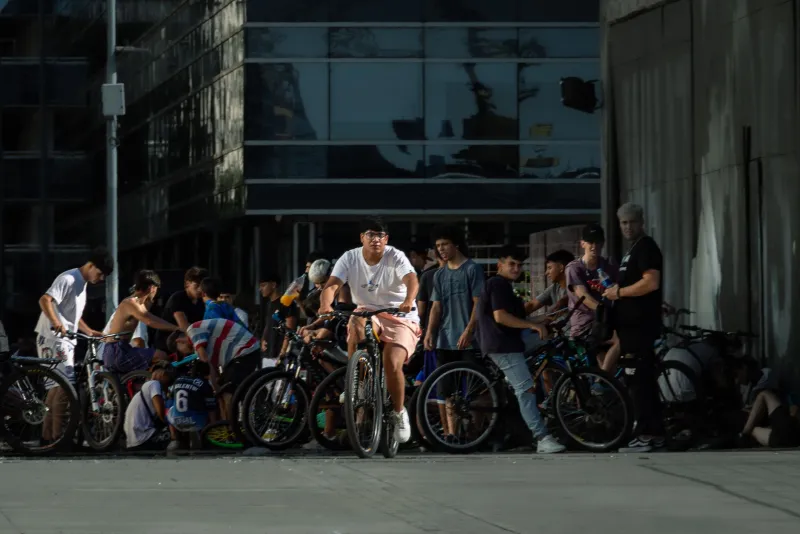
The movement doesn't have a single name or a central headquarters. It lives in group chats, borrowed parking lots, and the muscle memory of people who have been riding these streets for years. Some participants call themselves route mappers—individuals who document safe cycling corridors through neighborhoods, distributing hand-drawn or digitally printed maps at laundromats, corner stores, and community centers. Others run what they call "patch collectives," informal repair workshops that pop up in driveways and church parking lots, usually on weekends, where anyone can show up with a broken bike and leave with a working one.
Then there are the cargo riders.
The Cargo Network Nobody Talks About
Along a corridor stretching roughly from South Mountain to the Laveen area, a loosely connected group of cyclists has spent the last two years building a neighborhood cargo bike network. The idea started simple: a few people with cargo bikes realized they could do grocery runs for elderly neighbors who didn't own cars. It grew from there.
Today the network—which participants are deliberately vague about naming publicly—operates what amounts to a hyper-local delivery and errand system. Prescription pickups. School supply drops. Bulk produce from a nearby community garden redistributed to families who can't easily get to a farmers market. All of it moving on two wheels, all of it organized through a combination of group texts and word-of-mouth trust.
"There's no app," says one participant, a woman in her late thirties who asked to be identified only as Renata. "That's kind of the point. It's just neighbors knowing neighbors."
Renata got into cargo cycling after her car broke down and she realized how profoundly the neighborhood was designed against her. "You look at a map of Phoenix and you think, okay, there's a bus. But the bus doesn't go where you need it to go when you need it to go there. And the roads—I mean, try crossing Baseline on a bike. It's terrifying."
The cargo network doesn't solve that terror. But it redistributes the burden, spreading the risk across people who have chosen to take it on together.
Midnight Repairs and the Mechanics Who Show Up
If the cargo network is the movement's circulatory system, the repair collectives are its immune response. Every week, in various corners of the Valley, volunteers who range from trained mechanics to enthusiastic amateurs set up folding tables loaded with tire levers, patch kits, chain lube, and whatever spare parts they've managed to accumulate through donations and dumpster luck.
The midnight timing isn't just aesthetic. Many participants work day jobs—construction, restaurant kitchens, warehouse shifts—that make daytime workshops impossible. The late hours also carry a certain charge, a sense of operating just outside the frame of official city life that feels, to the people involved, entirely appropriate.
João Ferreira, a former bike shop employee who now runs a repair collective out of a parking lot near the I-10 corridor, says the workshops have become as much about community as mechanics. "People come in with a flat tire and they end up staying two hours. They meet their neighbors. They learn something. That's the whole thing, really."
João estimates he's helped restore more than 300 bikes in the past year, most of them going back into the hands of people who rely on cycling not as a lifestyle choice but as their primary way of getting around.
The Legal Gray Zone
None of this is without risk. Guerrilla road markings technically constitute vandalism under Arizona law, and participants are aware that a call to the city or a confrontation with law enforcement could complicate things quickly. Most operate on the assumption that low-profile, community-serving work tends to fly under the radar—and that the markings they make are often genuinely useful enough that nobody bothers to complain.
City officials, when asked about the phenomenon, have offered responses ranging from cautious acknowledgment to bureaucratic non-answers. A spokesperson for the Phoenix Street Transportation Department noted that the city "encourages community input on cycling infrastructure" and pointed to existing public comment processes. The cyclists on the ground find this response predictable.
"They have a process," Marcus says. "The process takes years. People are riding these streets right now."
What the Valley Could Learn
There's a version of this story that frames these cyclists as troublemakers, and there's a version that frames them as heroes. The truth is probably more textured than either. What they're doing is filling a gap—imperfectly, informally, with spray paint and zip ties and the willingness to show up at midnight—that formal city planning has left open for decades.
Other cities have watched similar grassroots movements eventually influence official infrastructure. In some cases, guerrilla bike lanes have been adopted and formalized after residents demonstrated demand. Whether Phoenix follows that trajectory remains to be seen. The city is changing fast, and the conversations about who that change serves are getting louder.
For now, Marcus finishes his stencil, caps the spray can, and steps back to look at the arrow pointing toward a safer crossing. It's not much. But it's there, on the asphalt, in the dark, pointing the way.
"Somebody's going to ride this tomorrow morning and not even know we were here," he says. "That's fine. That's the whole point."